


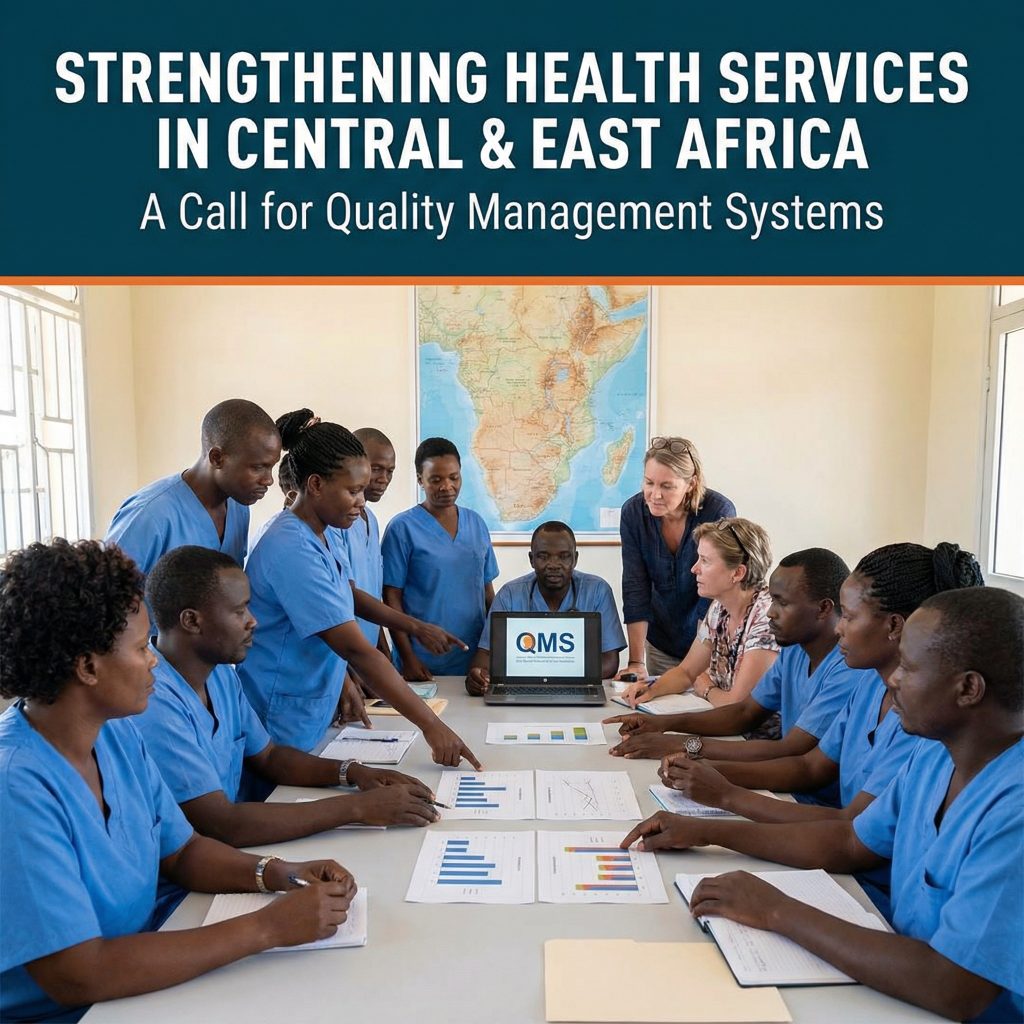
Health systems in Central and East Africa continue to face significant challenges in providing reliable, accessible, and quality care to their populations. The Democratic Republic of Congo (DRC) and Kenya, two of the region’s largest countries by population, reflect contrasting experiences in quality assurance and health system development.
Despite progress in expanding access, disease burden remains high, particularly from communicable diseases such as malaria, tuberculosis, and HIV/AIDS, as well as rising non-communicable diseases. Limited resources, fragmented healthcare governance, and inequitable service distribution further undermine the delivery of effective care.
Kenya’s Experience with Quality Management in Health Service
Kenya has made important strides in adopting structured frameworks for health service quality improvement. The Ministry of Health, in collaboration with development partners, has rolled out initiatives such as Standards-based Management and Recognition (SBM-R) and Kenya Quality Model for Health (KQMH). These frameworks emphasize:
- Standardized processes for service delivery
- Performance measurement and continuous improvement
- Regular assessments and quality improvement cycles
Kenya has also embraced several international quality and safety standards, particularly through accreditation of facilities and adoption of elements aligned with ISO-based thinking in areas such as patient safety, documentation control, and continuous monitoring.
While the adoption of formal ISO 9001 Quality Management Systems (QMS) in public health institutions is still developing, there is a growing appreciation of structured quality frameworks that promote accountability, reduce errors, and improve health outcomes. Capacity-building efforts, quality assurance units, and performance measurement systems have been integrated into national health strategic plans.
DRC: An Emerging Need for Structured Quality Management
In contrast, the DRC’s health sector has yet to institutionalize a national framework comparable to Kenya’s for systematic quality improvement. Despite clinical guidelines and some program-specific quality efforts, there is no national policy yet mandating implementation of internationally recognized QMS such as ISO 9001 in health facilities.
Consequently:
- Process standardization remains inconsistent across provinces.
- Patient safety systems are unevenly applied.
- Quality monitoring and impact evaluation are largely fragmented.
- Institutional mechanisms for continuous improvement are limited.
Given the vast geography and fragile governance contexts, implementing structured quality standards represents both a critical need and an opportunity to significantly reduce mortality and morbidity rates.
Why Quality Management Systems Matter in Healthcare
A formal Quality Management System — such as ISO 9001 — provides a systematic, process-driven framework that helps health facilities:
- Standardize leadership, processes, and accountability
- Clarify roles in clinical and administrative functions
- Monitor performance with measurable indicators
- Engage in continual improvement
- Enhance patient satisfaction and safety
- Strengthen documentation and audit trails
Across other sectors, ISO 9001 has demonstrated measurable improvements in operational efficiency, service reliability, and stakeholder confidence. Applying similar quality structures to health services can reduce clinical errors, improve resource utilization, and strengthen community trust in health systems.
The Role of Consultancy in Advancing Quality Standard
Consultancy firms like Zylloo Consult play a strategic role in enhancing health service quality through tailored support for health institutions, governments, and partners. Expert consultancies provide:
1. Quality Management System Assessment & Customization
- Conduct baseline quality audits to map existing processes
- Identify gaps relative to ISO 9001 requirements
- Develop practical, context-specific quality frameworks
2. Capacity Building & Training
- Train health managers and staff in QMS principles
- Build skills in documentation, data analysis, and performance monitoring
- Support development of internal quality assurance teams
3. Implementation Support
- Guide the development of standard operating procedures
- Facilitate data collection, reporting, and feedback loops
- Support pilot implementation and scale-up strategies
4. Certification Readiness
- Prepare documentation and systems to meet ISO 9001 or other quality standards
- Conduct internal audits and corrective action planning
- Support external audit readiness for certification
5. Continuous Improvement and Monitoring
- Design monitoring frameworks with measurable key performance indicators (KPIs)
- Support periodic reviews and quality improvement cycles
- Strengthen learning mechanisms and institutional memory
In conclusion, health services in Central and East Africa, particularly in the Democratic Republic of Congo and Kenya, face enormous challenges but also promising opportunities for transformation. While Kenya has made commendable progress in adopting quality frameworks, there remains room to strengthen systematic quality management. In the DRC, the absence of formal quality standards presents a clear opportunity for structured quality reform.
Consultants like Zylloo Consult are uniquely positioned to support this transition — bridging technical expertise, local context understanding, and international quality standards. By enabling health systems to embrace robust Quality Management Systems, we can improve clinical outcomes, enhance operational performance, and ultimately save lives.
Schedule a meeting with the Zylloo expert now for more guidance in adopting ISO 9001 QMS.
By Cezzy Kanionga, Consultant